
Roo Casino and Australian Online Casino Law: What ACMA Rules Mean
 Available in US
Australian federal law prohibits gambling providers from offering online casino services to people in Australia. The key statute is the Interactive Gambling Act 2001, and the Australian Communications and Media Authority (ACMA) administers and enforces important parts of that regime. ACMA explicitly lists online casinos among the banned services.
That rule is about the provision of the service. It should not be stretched into a blanket statement that an Australian player automatically commits a criminal offence merely by visiting or using an offshore casino. It also does not prove that Roo Casino refuses Australian registrations. Roo’s separate licensing position is covered in the Roo Casino licence. Australian law sets the rules for online casino services, while ACMA is responsible for enforcement; the regulatory position also changed in 2026.

Table of Contents
- The Interactive Gambling Act sets the federal online rules
- ACMA’s rule is framed around the provider
- Online casinos are different from licensed online wagering
- Commonwealth and state or territory regulation work side by side
- ACMA can use website blocking as an enforcement tool
- Advertising prohibited services is also restricted
- The 2026 reform package is now part of the legal landscape
- Financial and infrastructure disruption now matter more
- Website access does not prove Australian regulatory approval
- Foreign licensing does not replace Australian authorisation
- What Australian readers should check before relying on a legal claim
- Read Roo through the Australian rules that actually apply
The Interactive Gambling Act sets the federal online rules
The Interactive Gambling Act 2001 is the central Commonwealth law governing the provision and advertising of interactive gambling services to people in Australia. It does not treat every form of online gambling in the same way. Some services are prohibited, while other regulated interactive gambling services can operate only within an Australian licensing framework.
ACMA’s current guidance says banned services include online casinos, in-play sports betting, sports betting services that do not hold an Australian licence, and betting on the outcome of a lottery. For a casino-focused reader, the important point is simple: online casino services sit in the prohibited category when they are offered to customers in Australia.
This federal rule is separate from the question of which foreign regulator licenses an offshore operator. A licence issued outside Australia can identify the operator and establish a regulatory relationship in that jurisdiction, but it does not convert an online casino into an Australian licensed service.
ACMA’s rule is framed around the provider
ACMA describes the offence in provider-side terms: gambling providers must not offer prohibited interactive gambling services to people in Australia. Its enforcement material repeatedly refers to companies providing prohibited services to customers physically present in Australia and to the Australian-customer link required by the legislation.
That distinction matters when reading phrases such as “illegal online casino”. In ACMA material, the description is generally about a service being provided in breach of the Interactive Gambling Act. It does not automatically answer every question about the personal legal position of an individual user.
For that reason, it is more precise to say that Australian law prohibits providers from offering online casino services to people in Australia than to use an unsupported blanket label about a player’s conduct. Anyone needing advice on a personal legal situation should obtain advice specific to their circumstances rather than relying on a general casino review.
Online casinos are different from licensed online wagering
Australia does have lawful online wagering services, but that does not create a general Australian licence pathway for internet casinos. ACMA distinguishes prohibited interactive gambling services from regulated interactive gambling services such as certain sports and race wagering products.
Regulated wagering services can require a licence allocated by an Australian state or territory. Online casino-style games such as slots, roulette, blackjack and similar internet casino products fall into a different category under the federal regime when provided to people in Australia.
This is why checking whether a wagering brand appears on an Australian register cannot be used to assume that an offshore casino has equivalent approval. The licensing overview for Roo Casino separates the brand’s foreign licence information from Australian regulatory status.
Commonwealth and state or territory regulation work side by side
Australian gambling regulation is divided between federal and state or territory systems. The Commonwealth framework deals with interactive gambling issues including prohibited online services and advertising. States and territories separately regulate gambling activities within their own licensing and regulatory structures.
This split can be confusing because a reader may hear that a gambling business is “licensed in Australia” without knowing which product the licence covers. A licence for wagering does not mean that the same operator can lawfully provide prohibited online casino games to Australian customers. The product category and the applicable legal rule matter.
For Roo Casino, the useful question is not whether some form of gambling is licensed somewhere in Australia. It is whether the specific online casino service falls within the Australian framework. ACMA’s guidance is clear that online casinos are among the banned services providers must not offer to people in Australia.
ACMA can use website blocking as an enforcement tool
ACMA actively investigates offshore gambling services and can ask Australian internet service providers to block access to websites found to be operating in breach of the Interactive Gambling Act. Its blocked-sites material explains that website blocking can be used where a site provides prohibited interactive gambling services to customers in Australia, provides certain unlicensed regulated services, or publishes prohibited gambling advertising.
ACMA reported in July 2026 that 1,774 illegal gambling and affiliate websites had been blocked since its first blocking request in November 2019, and that more than 230 illegal services had withdrawn from the Australian market since strengthened enforcement began in 2017. Those figures show that the blocking program is an active enforcement mechanism rather than a theoretical power.
This does not mean Roo Casino itself should be described as blocked unless there is specific current evidence for that claim. A general description of ACMA’s enforcement powers cannot be turned into a brand-specific enforcement finding.
Advertising prohibited services is also restricted
The Interactive Gambling Act does not focus only on the underlying gambling service. ACMA also states that banned services must not be advertised in Australia. Its guidance covers advertising for prohibited interactive gambling services such as online casino-style products.
That distinction is relevant when reading casino content online. An informational explanation of how Australian law works is different from promotional material designed to induce use of a prohibited service. Australian regulatory restrictions therefore deserve clear separation from promotional sign-up messaging.
Advertising rules have also been a major focus of the 2026 reform package, making the date of any legal summary important. Older articles written before August 2026 may not reflect the latest statutory changes.
The 2026 reform package is now part of the legal landscape
Australia passed a further package of interactive gambling reforms in August 2026. The Interactive Gambling Amendment (Gambling Reform) Act 2026 received assent on 26 August 2026 and the Federal Register lists the Act as in force. The package contains measures dealing with wagering advertising, disruption of illegal gambling services, BetStop, inducements and related enforcement mechanisms.
ACMA’s updated Interactive Gambling Act guidance now includes a dedicated section on the 2026 changes. The reforms broaden the contemporary compliance picture beyond the longstanding ban on online casino services. They include tighter advertising controls and stronger mechanisms aimed at disrupting illegal gambling activity.
For a reader comparing Roo Casino with Australian rules, the important point is chronological: the core provider-side prohibition on online casinos is not new, but the enforcement and advertising framework continued to evolve in 2026. Legal articles that stop at the 2017 or 2019 reforms are therefore incomplete for a current Australian audience.
Financial and infrastructure disruption now matter more
The 2026 amending Act contains a schedule specifically titled “Disruption of illegal gambling services”. It includes measures dealing with blocking financial transactions, illegal gambling advertising, preventing the use of infrastructure for illegal gambling and expanded enforcement powers.
That matters because modern enforcement is not limited to publishing warnings or sending notices to operators. The statutory direction is toward making prohibited services harder to provide, promote and support through the systems they depend on.
Readers should still avoid assuming that every power has been used against every offshore brand. Enforcement tools describe what regulators can do and what the law permits; a brand-specific statement needs brand-specific evidence.
Website access does not prove Australian regulatory approval
An offshore casino website being reachable from a device in Australia is not evidence that ACMA has approved it. Technical accessibility, foreign licensing and Australian legal status are separate questions. A site can be accessible at one moment while still falling within a prohibited service category under Australian law.
The reverse is also true: a temporary access problem does not by itself prove that ACMA has blocked a particular site. Networks, hosting providers, security systems and regional settings can all affect access. ACMA maintains specific information about blocked gambling websites, so a brand-specific blocking claim should be tied to that evidence rather than inferred from a browser error.
For Roo, practical product features and Australian legal context should therefore be evaluated separately. The main Roo Casino Australia review keeps those two questions distinct.
Foreign licensing does not replace Australian authorisation
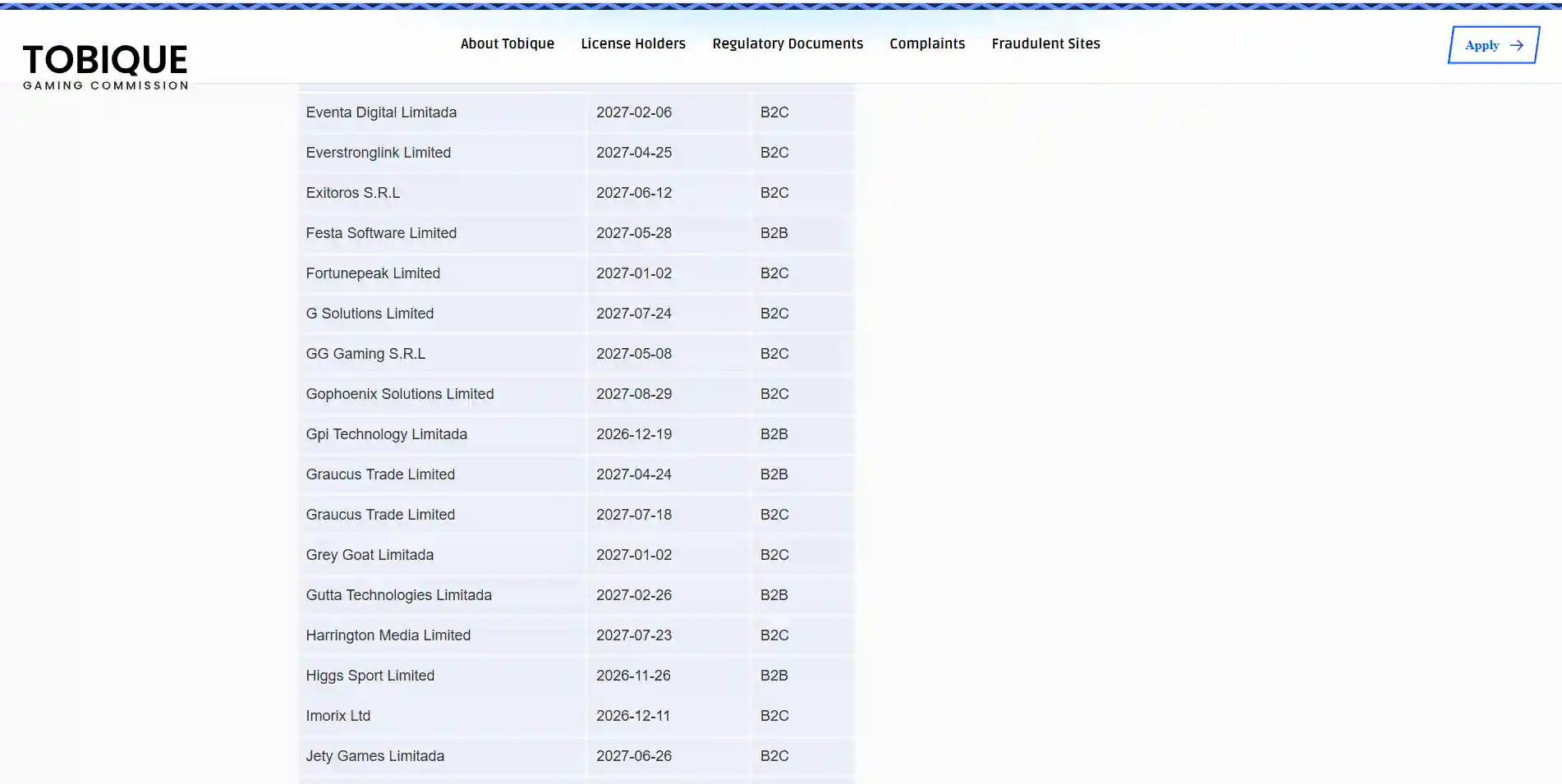
Roo Casino’s operator, Gophoenix Solutions Limited, has a foreign B2C licence listing with the Tobique Gaming Commission. That is relevant to operator identity and the foreign regulatory framework, but it does not amount to an Australian gambling licence.
When assessing consumer protection, avoid assuming that a foreign licence gives access to the same complaint systems, self-exclusion coverage or statutory protections associated with Australian licensed wagering. The jurisdiction granting the licence determines the regulatory relationship.
The practical implications are discussed further in the Roo Casino reputation and safety, which looks at operator identity, third-party complaint signals and account-risk checks without treating a licence badge as a payout guarantee.
What Australian readers should check before relying on a legal claim
- Check the date. Australian interactive gambling law changed again in August 2026, so older summaries can be incomplete.
- Check the service category. Online casino games and licensed online wagering are not treated identically.
- Separate provider and player language. A prohibition on supplying a service should not be rewritten as a personal criminal-liability claim without supporting law.
- Separate foreign and Australian licensing. An overseas licence does not mean ACMA approval.
- Look for brand-specific enforcement evidence. Do not infer that a particular casino is blocked merely because ACMA blocks illegal gambling sites generally.
- Keep tax separate. The tax treatment of gambling winnings answers a different question from whether an online casino service may be provided in Australia.
The last point is especially important because tax and gambling regulation are often incorrectly blended together. The Australian gambling tax rules explains the separate ATO position for recreational gambling and gambling carried on as a business.
Read Roo through the Australian rules that actually apply
For the broader brand overview, see the Roo Casino Australia review. The clearest way to understand Roo Casino in an Australian context is to keep three questions separate. First, what product does the site provide? Second, what foreign licence identifies the operator? Third, what does Australian law allow providers to offer to people in Australia?
For the third question, ACMA’s current position is direct: online casinos are banned services under the Interactive Gambling Act, and providers must not offer them to people in Australia. ACMA actively investigates breaches, uses ISP blocking and enforces advertising restrictions. The 2026 reform package has further strengthened the modern framework.
None of that requires exaggerating the rule into claims the primary sources do not make. A precise legal summary is more useful than a blanket label: Australian law restricts the provider-side supply of online casino services, foreign licensing does not create Australian approval, and any personal legal question should be assessed on its own facts.
Written by the editors at roo Casino.